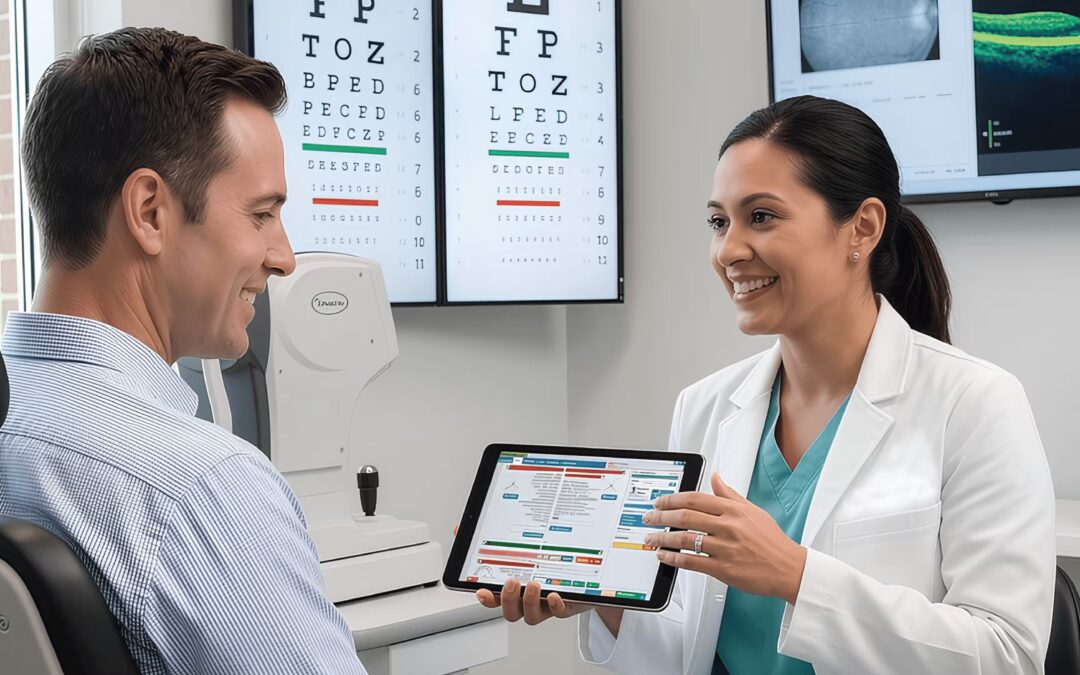
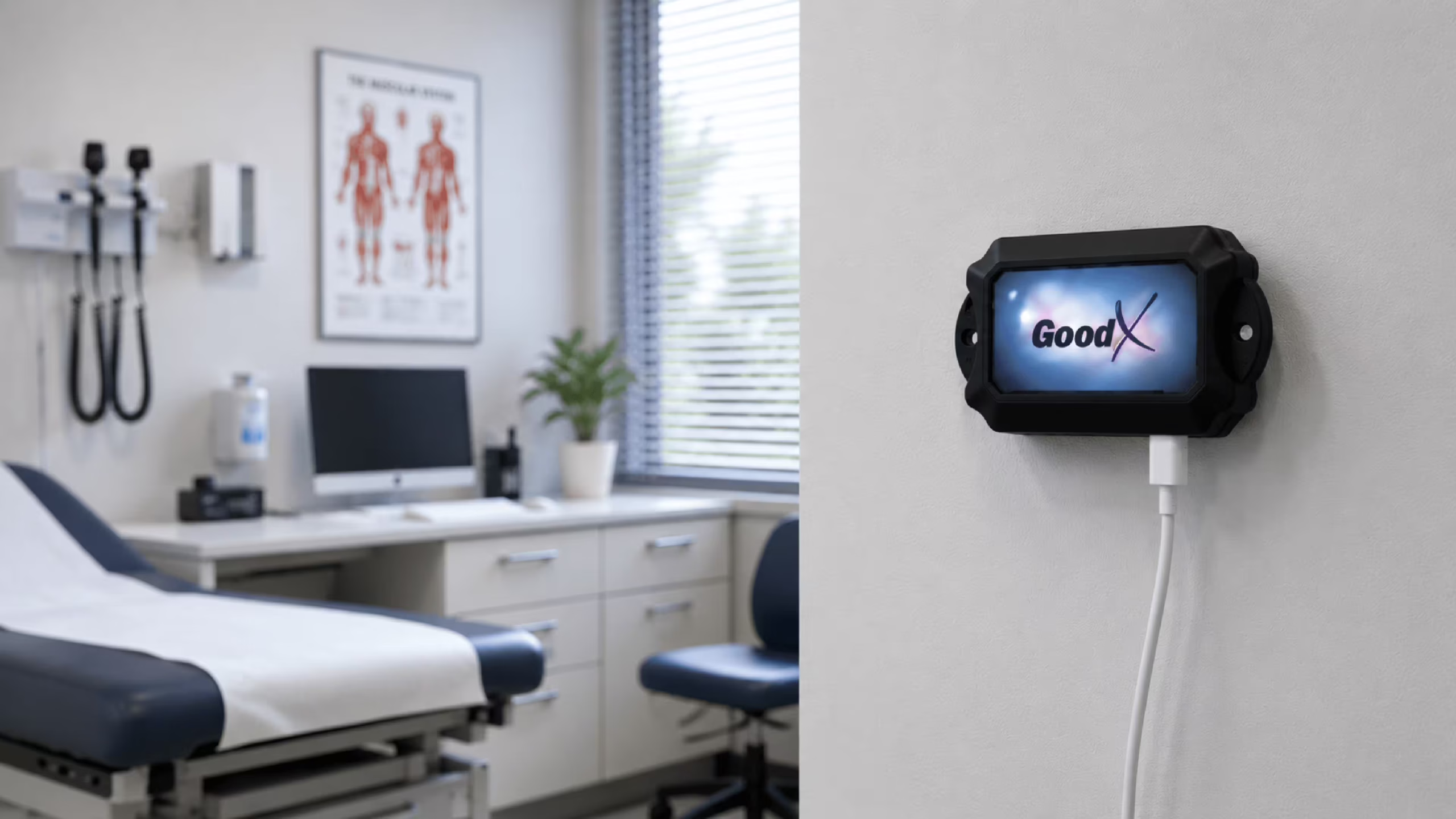
Radio Frequency Identification (RFID) is not new technology, but its application in healthcare settings, and specifically in ophthalmology clinics, is a genuinely recent development with meaningful practical implications for how eye care practices manage patient flow. For busy ophthalmology clinics where a single patient visit involves multiple touchpoints, sequential testing, and time spent in different waiting areas, RFID offers a way to track and advance patient status automatically, reducing manual coordination and improving the overall experience for patients and staff alike.
This article covers the basics of RFID technology as it applies to ophthalmology, how GoodX uses RFID to advance patient booking status in real time, and why this technology is emerging as a meaningful tool for ophthalmology practices looking to run more efficiently without adding administrative headcount.
Emerging Technologies in Ophthalmology: The RFID Conversation
The intersection of technology and eye care has produced some of the most exciting advances in modern medicine, from AI-assisted diagnostic imaging to precision surgical robotics. RFID is a different kind of technology, less dramatic perhaps, but with highly practical application to the daily operational challenges of a busy ophthalmology practice.
For a detailed discussion of how RFID and other emerging technologies are being applied in ophthalmology specifically, the GoodX Talks podcast episode on emerging technologies in ophthalmology is worth listening to. This episode covers the practical application of technologies including RFID in the context of real ophthalmology clinic workflows, with insights from practitioners who have implemented these tools and observed the results.
The broader trend toward technology-enabled patient flow management in specialist clinics is well-documented. According to the World Health Organization, global demand for eye care services is growing rapidly as populations age and the prevalence of conditions like diabetic retinopathy and age-related macular degeneration increases. Clinics that can manage higher patient volumes efficiently, without compromising on care quality or patient experience, are better positioned to meet this demand.
RFID is one of the tools that makes this possible in an ophthalmology setting, specifically because the multi-step nature of an ophthalmic patient visit creates coordination challenges that manual tracking cannot solve at scale.
What Is the Main Purpose of RFID?
RFID stands for Radio Frequency Identification. It uses radio waves to identify and track tags attached to objects or people. Each RFID tag contains a chip and an antenna. When the tag comes within range of an RFID reader, it transmits its unique identifying information without any direct contact and, importantly for clinical settings, without requiring the tag to be visible to the reader.
What is the main purpose of RFID? In its most common commercial applications, RFID is used for inventory tracking, access control, and supply chain management. In healthcare, the same underlying technology is applied to asset tracking (locating medical equipment in a hospital), medication management (tracking drug distribution), and increasingly, patient flow management in clinical settings.
The value of RFID in a clinical context lies in its ability to provide real-time location and status information without requiring any action from the patient or the staff member. A patient wearing an RFID wristband does not need to check in at each station manually. The system knows they have moved from the waiting area to the pre-testing room because the RFID reader in that room has detected their tag.
This automatic, passive tracking is particularly well-suited to ophthalmology clinic workflows where patients move through multiple stages, often with different staff involved at each stage, and where the clinical team needs to know at a glance where each patient is in their journey without interrupting care to ask.
The International Agency for the Prevention of Blindness highlights patient experience and clinical efficiency as central concerns for eye care services globally. Technologies that reduce wait times, eliminate coordination confusion, and give patients and staff a clear view of where each person is in their clinic journey directly address both priorities.
Does RFID Need Line of Sight?
This is one of the most practically important questions for anyone considering RFID in a clinical environment. Does RFID need line of sight? No, it does not. This is one of the key advantages of RFID over barcode scanning, which requires direct visual alignment between the scanner and the barcode to read.
RFID readers detect tags through walls, around corners, and through non-metallic materials. In a clinic setting, this means a reader positioned at the entrance to a room can detect patients with RFID wristbands as they enter, without requiring the patient to hold up a card or look at a scanner. The detection is automatic and passive.
The range of detection depends on the type of RFID system. Passive RFID tags, which carry no internal battery and are powered by the reader’s radio field, typically have a shorter detection range, from a few centimetres to several metres depending on frequency. Active RFID tags, which contain their own battery, can be detected at much greater distances but are more expensive and require battery management.
For patient flow management in an ophthalmology clinic, passive RFID with short to medium range is typically the right choice. The goal is to detect when a patient has entered a specific zone, not to track them across a large outdoor area. This makes the system cost-effective to implement while still delivering the real-time location information that enables automatic booking status advancement.
Can RFID Be Used for Tracking? How GoodX Uses It to Advance Booking Status
Can RFID be used for tracking? Absolutely, and this is precisely how GoodX applies the technology in ophthalmology practice settings. GoodX uses RFID to advance patients’ booking status automatically as they move through the different stages of their clinic visit.
Here is how it works in practice. When a patient arrives at the clinic, they are given an RFID-enabled patient tag or wristband. As the patient moves from the reception area to the pre-testing room, the RFID reader in that zone detects their arrival and automatically updates their status in the GoodX system from “Waiting” to “In Pre-Testing”. When they complete pre-testing and move to the consultation waiting area, the status updates again. When they enter the consulting room, the ophthalmologist’s interface shows the patient is present and their pre-testing results are already attached to their consultation record.
This automatic status advancement eliminates the need for manual check-ins at each stage, reduces the coordination calls between reception, pre-testing technicians, and consulting rooms, and gives the entire clinical team a live view of where every patient is in their visit journey. For a clinic managing 50 to 100 patients a day across multiple consulting rooms and testing stations, this is a significant operational improvement.
The benefits extend to patient experience as well. Patients who can see a clear status display of where they are in their journey, rather than sitting in a waiting room with no information about when they will be seen next, report significantly lower anxiety and higher overall satisfaction with their visit.
Frequently Asked Questions
What is RFID and how is it used in ophthalmology?
RFID (Radio Frequency Identification) is a technology that uses radio waves to identify and track tags without requiring physical contact or line of sight. In ophthalmology, RFID is used for patient flow management, specifically to track patients as they move through the different stages of a clinic visit, from reception through pre-testing to consultation. GoodX uses RFID to advance patient booking status automatically in real time.
Does RFID need line of sight to work?
No. Unlike barcode scanning, RFID does not require line of sight between the tag and the reader. RFID readers can detect tags through walls and around corners, which makes them ideal for clinical settings where patients move between rooms and zones. Detection is automatic and passive, requiring no action from the patient or staff member.
Can RFID be used for patient tracking in an eye clinic?
Yes. RFID is well-suited to patient tracking in an ophthalmology clinic because the multi-step nature of an ophthalmic patient visit creates coordination challenges that manual tracking cannot solve efficiently at scale. GoodX uses RFID specifically to advance patient booking status as patients move through reception, pre-testing, and consultation areas, giving the entire clinical team a real-time view of each patient’s location and progress.
What is the main purpose of RFID in healthcare?
In healthcare, RFID serves several purposes including asset tracking, medication management, and patient flow management. In an ophthalmology clinic context, the primary purpose is patient flow optimisation: tracking where each patient is in their clinic journey and automatically updating their status in the practice management system, so clinical and administrative staff always have an accurate, real-time picture of who is where.
How does RFID improve patient experience in an ophthalmology clinic?
RFID improves patient experience by eliminating manual check-ins at each stage of the visit, reducing unexplained wait times through visible status updates, and enabling the clinical team to coordinate patient movement more efficiently. Patients who can see where they are in their visit journey and who spend less time waiting without information report significantly higher satisfaction scores than those managed through manual coordination systems.
See RFID Patient Tracking in Action with GoodX
GoodX combines advanced ophthalmology practice management tools with emerging technologies including RFID patient tracking to help eye clinics run more efficiently and deliver a better patient experience.